
Natsuki Toda and Kasama ware
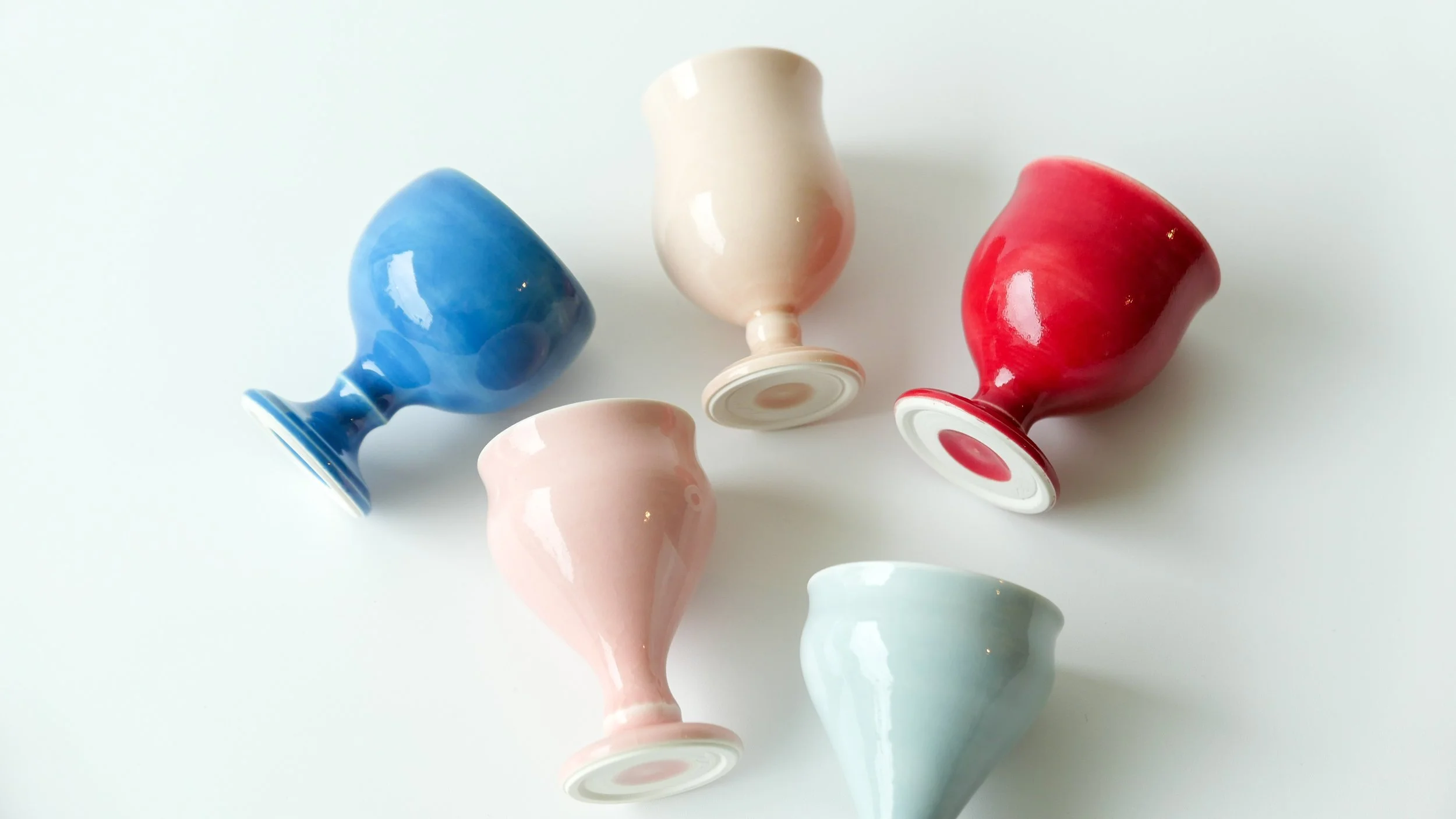
Natsuki Toda from Kasama,
a town that never settled
There is a phrase people use about Kasama, the pottery town in Ibaraki where Natsuki Toda works: its defining characteristic is that it has no characteristic.
Natsuki said it to me almost as an aside, and I wrote it down because I found it intriguing that a town with no defining character could still be known as a pottery town.
Most Japanese pottery towns can tell you what they are in a sentence. Arita has porcelain and cobalt line work. Bizen refuses glaze altogether. Shigaraki has coarse, iron-flecked clay and the marks the kiln leaves on it. These are rules accumulated over centuries, and a potter who settles there inherits them whether or not they asked to.
Kasama never arrived at its sentence. And the reason turns out to be more interesting than an absence.
History
In 1772, the headman of Hakoda village — now the city of Kasama — a man named Hanuemon Kuno, began firing pots under the instruction of a potter called Chōemon, who had come from Shigaraki. This is the documented beginning of what became Kasama ware.
What Kasama made for its first century was storage jars, mortars, plain brown vessels for pickled plums and miso. Farm-kitchen goods.
By the mid-twentieth century Kasama was close to finished. Plastic had taken the everyday goods market. Only a handful of kilns were still lit.
What happened next was policy. Ibaraki Prefecture opened a pottery training centre in 1950, then built an art village in 1966 and housing for potters in 1972 — an explicit campaign to import individual artists from outside the region and give them somewhere to live and work. It worked. Potters came, from inside the prefecture and well beyond it.
So the freedom began as a vacancy. Almost none of Kasama's own potters were left. But the people who came from outside embraced that freedom and made whatever they wanted.
Natsuki Toda
Natsuki Toda used to work in healthcare.
On a day off, she went to Kasama. Her grandparents had lived there, so the town was background scenery, the kind of place you don't look at properly. This time she noticed the ceramics college. She had always liked to draw and make things, and so she enrolled.
The cat was there before the clay was — it had been her subject for a long time.
What the college gave her was a sharper version of the question: how little can remain and still be unmistakably a cat?
It's a harder question than it sounds. Too much detail and the object becomes an ornament, sitting on a shelf performing cuteness at you. Too little and it's a curved form with nothing inside it. The answer occupies a narrow band, and she has been working inside that band ever since.
Where the shapes come from
The cups are the clearest evidence that this is a method and not a look.
She built them from a cat's silhouette, the line of the back and the taper below it. The consequence — which she did not design, and found out by drinking from them — is that the curve meets the hand correctly and the rim meets the lip at the right angle. Form pursued for one reason arriving at function for another.
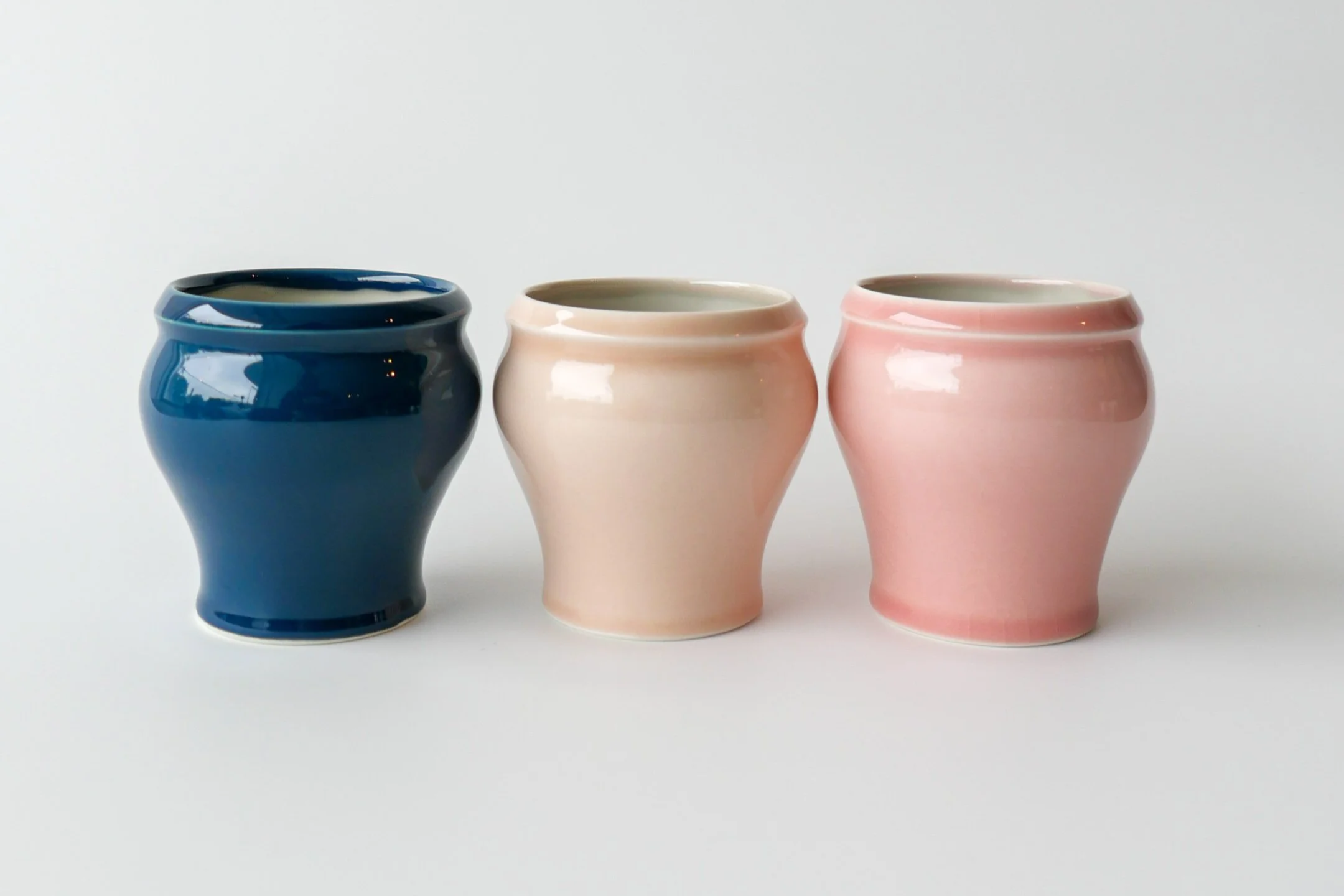
Cups from Natsuki Toda
The goblets came from a lapse in attention. She was turning teapot handles at the workshop where she trained, and one of them looked to her like the stem of a goblet. So she made goblets.
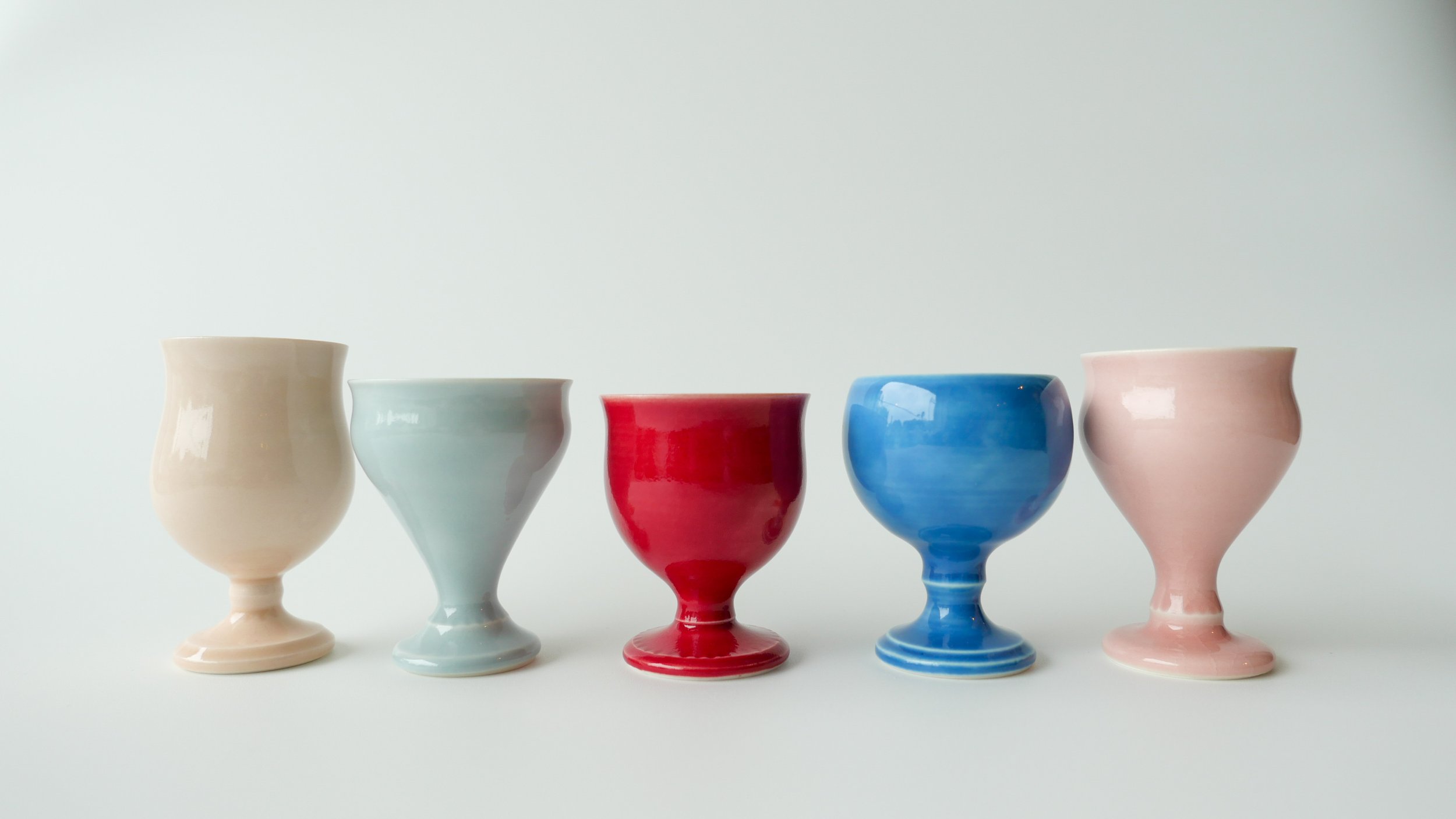
Small goblets from Natsuki Toda
The cat objects are pinched by hand. The cups and goblets are thrown. The pitchers are slip-cast from plaster moulds taken off her graduation piece. She fires in an electric kiln installed in the bicycle shelter at her house — bisque at 800°C, glaze, then 1250°C — about once a month, which yields somewhere between forty and sixty cups.
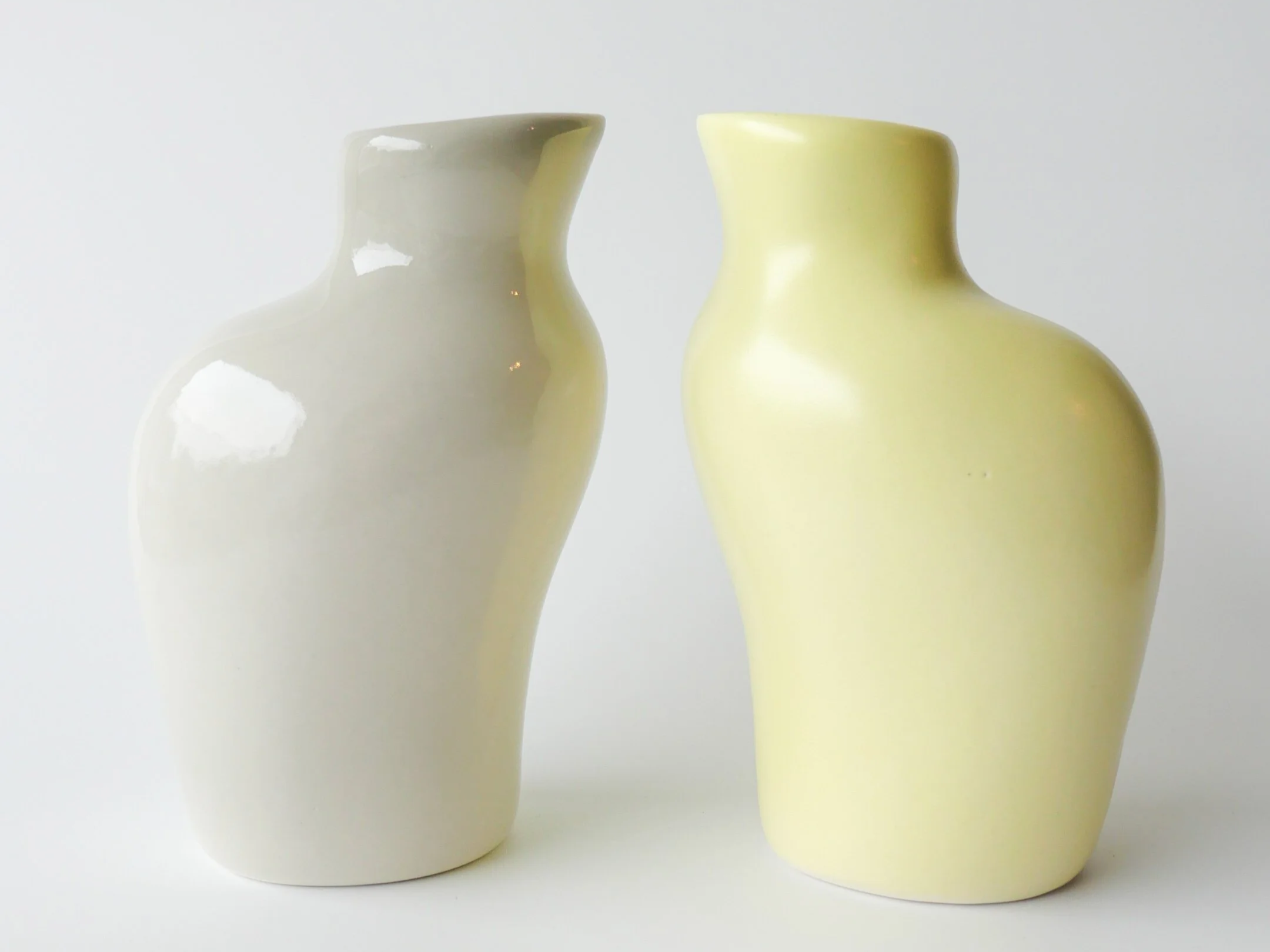
Water pitchers from Natsuki Toda
Why these are in Groningen
I carry Natsuki's work because I love the way a single piece of hers can brighten an entire room. Her pieces obviously appeal to people who love cats, but they settle just as naturally into the lives of people who don't particularly care for them.
And true to Kasama's character, her work isn't traditionally Japanese in its design. It's more modern, yet it still finds its beauty in a very Japanese restraint: few colours, little ornament.
Natsuki Toda's cups, goblets, cat objects and pitchers are available at MADOI. Each is made by hand in Kasama, Ibaraki.
